Support for Changes in the Fertilizer Subsidy Scheme, Coordinating Minister for Food: Pupuk Indonesia Can Revitalize Its Factories
-
 Posted by User01
- Share


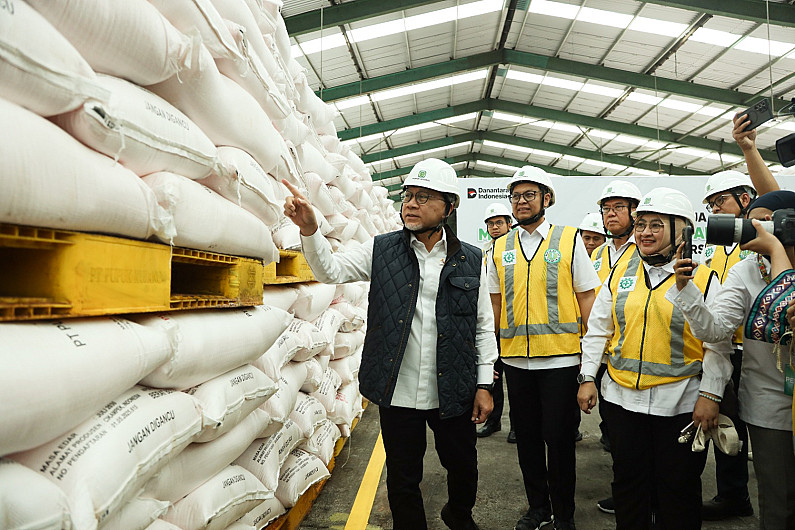
Coordinating Minister for Food Affairs (Menko Pangan) Zulkifli Hasan expressed his appreciation for the efficiency measures implemented by Pupuk Indonesia, which have supported the company’s plans to revitalize its aging fertilizer plants and even reduce the Maximum Retail Price (HET). The Coordinating Minister made this statement during his visit to the Pupuk Kujang Cikampek plant in Karawang, West Java, on Thursday (November 6, 2025).
With the change in the fertilizer subsidy scheme, the Coordinating Minister stated that in the future, Pupuk Indonesia will be able to revitalize and even build more efficient fertilizer plants.
“With the marked-to-market scheme, Pupuk Indonesia can build one new plant every year. The savings can also provide a 20 percent discount on subsidized fertilizer prices,” said the Coordinating Minister.
Minister Zulkifli Hasan (Menko Zulhas) emphasized that the plant revitalization program at Pupuk Indonesia is crucial, as many of the company’s factories are over 30 years old.
He further added that the revitalization effort is also necessary to increase domestic fertilizer production capacity. This initiative aligns with the vision of President of the Republic of Indonesia, Prabowo Subianto, as stated in the Asta Cita program to achieve national food self-sufficiency.
“We need to increase fertilizer production capacity to achieve food self-sufficiency. We are developing new agricultural lands, such as in Merauke, where there are over one million hectares, so we will need more fertilizer. That’s not even counting horticulture. Fertilizer will continue to be essential, and the demand will keep growing. Fertilizer is a strategic commodity that supports our food sovereignty,” the Coordinating Minister asserted.
Meanwhile, Corporate Secretary of PT Pupuk Indonesia (Persero), Yehezkiel Adiperwira, stated that the Coordinating Minister’s visit to Pupuk Kujang represented the government’s support for the revitalization plans to be implemented by Pupuk Indonesia.
“Going forward, there will be many improvements and plant revitalizations in line with the President’s directive to achieve national food self-sufficiency. During the plant tour, the Coordinating Minister saw firsthand the factories that are indeed due for revitalization,” he explained.
To ensure that production capacity meets the needs of Indonesian farmers, Pupuk Indonesia plans to execute seven projects by 2029—not only focusing on revitalization but also on downstream development (hilirisasi).
“One of the ongoing projects is the revamping at Pupuk Kalimantan Timur and the construction of the Pusri 3B plant at Pupuk Sriwidjaja Palembang. Through these two revitalization projects, we aim to ensure that production capacity can meet domestic demand,” he said.
“As for downstream development, Pupuk Indonesia recently held the groundbreaking ceremony for the Soda Ash Plant at Pupuk Kalimantan Timur. This marks one of the company’s concrete commitments to advancing downstream industrial development,” he concluded.